The Integral Role of Structured Journals in the Recovery Journey
For individuals navigating the path of addiction recovery, the process is often described as a journey—one that requires immense personal commitment, structured support, and daily reflection. While clinical therapy and peer groups provide essential frameworks, the personal, private practice of journaling has emerged as a cornerstone of sustainable recovery. This is where specialized tools, such as an Addiction Recovery Planner-KDP Interiors, transform a simple notebook into a powerful, personal roadmap.
Understanding the Designed Recovery Companion
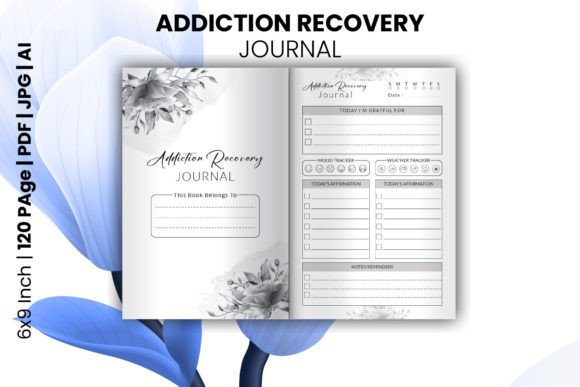
The concept of a recovery journal goes beyond blank pages. It is a purpose-built interior layout engineered to guide the user through the complex emotional and logistical terrain of rebuilding their life. A product like the Addiction Recovery Journal Notebook for KDP business represents this evolution. It is not merely a stationery item; it is a functional aid that incorporates prompts, trackers, and structured sections which mitigate the overwhelm that can accompany early recovery days.
These interiors typically feature dedicated areas for daily mood and craving logs, gratitude exercises, milestone recognition, and weekly goal setting. The design intentionality is key. By providing a clear structure, it reduces the cognitive load on the user, allowing them to focus on the content of their reflection rather than the organization of it. For the creator or entrepreneur in the KDP space, offering such a tailored product meets a specific, profound need in the marketplace.
Practical Applications in Daily Recovery Management
Consider the morning routine of someone in recovery. Facing a day without familiar coping mechanisms can be daunting. A journal with a pre-formatted daily page offers an immediate anchor. It might begin with a simple prompt: “Today, I am committed to…” This sets a positive, proactive tone. Throughout the day, the user can track triggers or moments of strength in designated sections, creating a tangible record that demystifies patterns of behavior.
Furthermore, these planners often include space for session notes—ideal for jotting down insights from therapy or support group meetings—ensuring key advice and personal epiphanies are captured and not lost. The practical utility extends to practical life rebuilding: sections for health habit trackers, financial planning, and relationship notes align the journal with holistic recovery principles. It becomes a single, confidential repository for the entire recovery endeavor.
Key Characteristics of a Professional Recovery Journal Interior
For the KDP business owner selecting or creating such a product, understanding the essential characteristics is crucial. The interior design must be both clinically informed and user-friendly.
- Non-Judgmental Structure: The language and prompts should be neutral and encouraging, avoiding any phrasing that could imply shame or failure.
- Visual Clarity and Space: Ample writing space with clean lines and clear section headings prevents the page from feeling cluttered, which is vital for someone potentially dealing with anxiety or focus challenges.
- Progressive Milestone Tracking: Features like “Days of Sobriety” counters or monthly reflection pages help visualize progress, providing powerful motivational feedback.
- Flexibility: While structured, it should allow for freeform expression. Some days require more venting, others more planning; the layout should accommodate both.
The technical offering of AI file, PNG, PDF, single page PDF, and a 120-page print-ready file in Letter size 6" x 9" with bleed is not just a list of formats. For the KDP publisher, it represents complete operational readiness. The AI file allows for deep customization for future editions or related products. The single-page PDF option is invaluable for testing print quality or creating sample pages for marketing. A fully prepared package accelerates the journey from design to upload.
The Dual Advantage: User Benefit and Creator Opportunity
The advantages of utilizing such a specialized journal are multifaceted. For the end-user, it provides consistency, which is a therapeutic principle itself. The act of daily engagement with the journal reinforces commitment and self-awareness. It creates a private, safe space for honesty that might not be possible even in group settings. Over time, the filled journal becomes a personal testament to growth, a concrete object disproving the notion of stagnation.
For the entrepreneur, the Addiction Recovery Planner-KDP Interiors niche addresses a market with ongoing demand. Recovery is a lifelong process, and tools that support it are not one-time purchases. Many individuals will use journals continuously or return to the practice during different phases of life. The product also has relevance for professionals—counselors, life coaches, or sober living facilitators might recommend or even distribute such journals as part of their program, expanding the potential customer base.
Implementing a Recovery Journal into Support Ecosystems
Observing real-world use cases reveals the journal’s versatility. In outpatient programs, it’s common for counselors to assign journaling homework; a structured planner simplifies this assignment and improves compliance. In peer-led recovery communities, journals are often shared as recommended tools during newcomer orientations. Furthermore, for the individual pursuing a self-directed recovery path, perhaps due to geographic or financial constraints, a well-designed journal can serve as a primary, accessible tool of self-guided therapy.
The considerations for a publisher are equally important. Ensuring the content is respectful and aligns with general recovery principles from multiple traditions (like 12-step, SMART Recovery, or holistic models) increases its applicability. The physical format—like the 6" x 9" size—is popular for its portability, fitting easily into a backpack or daily carry, making the practice more mobile and integrated into daily life.
Trends and Evolution in Recovery Support Tools
The field of recovery support is evolving towards greater personalization and empowerment. Digital apps exist, but the tactile, analog nature of a physical journal offers a distinct value: it is disconnected from the distractions of devices, it encourages slower, more deliberate thought, and it exists entirely under the user’s control with no data privacy concerns. The trend in KDP interiors is towards even more nuanced specialization—journals for specific substance recoveries, for co-dependency, or for family members affected by addiction.
This evolution underscores the importance for creators to have editable files. The provided AI file format is the key to adapting and staying relevant. It allows a business to iterate based on user feedback, create complementary products like companion gratitude journals or annual reflection books, and build a cohesive brand within the recovery support niche on their KDP profile.
Ultimately, the creation and provision of a tool like an Addiction Recovery Journal Notebook is a meaningful intersection of commerce and care. It fulfills a Helpful Content principle by providing a tangible solution to a complex human challenge. By offering a ready-to-upload, professionally formatted product, the KDP business owner removes technical barriers for themselves and provides a functional barrier-remover for the individual in recovery. The journal stands as a quiet partner in the journey, its pages holding the unfolding story of resilience, one day at a time.