Checkbook Register Journals: Navigating Your KDP Interior Options
For entrepreneurs and creators building a publishing business on platforms like Amazon KDP, interior design is a foundational decision. A well-structured interior directly influences user experience, perceived value, and ultimately, sales. Among the many niche offerings, products like the Checkbook Register Journal–KDP Interior represent a specialized tool for those targeting the financial planning and personal budgeting market.
Understanding the Checkbook Register Journal Interior
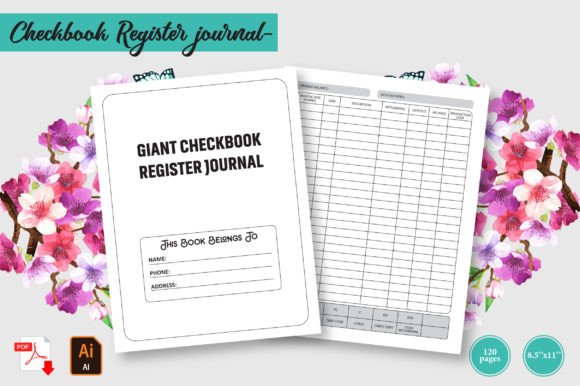
At its core, a Checkbook Register Journal–KDP Interior is a pre-designed, formatted template specifically for creating a physical journal dedicated to tracking financial transactions. It transforms a blank canvas into a ready-to-publish book interior, eliminating the need for manual layout design from scratch. The distinct value lies in its specificity. Unlike a generic lined journal interior, this product is built around the logical structure of a financial register, typically including fields for date, description, debit, credit, and balance.
What makes this particular offering distinct, based on its specifications, is its focus on technical readiness and customization. Key features often include a standard US letter size (8.5x11 inches), 120 pages, and delivery in multiple file formats like PDF, JPEG, and editable Adobe Illustrator files. The mention of 100% formatting and thorough testing suggests an emphasis on print-ready precision, crucial for avoiding costly publishing errors. The "no bleed" specification indicates it’s designed for interiors where graphics or color do not extend to the edge of the page, which is typical for text-centric journals.
Comparing Interior Design Approaches
When evaluating how to produce a checkbook register journal, creators typically face several paths, each with its own tradeoffs.
Using a Pre-Made, Specialized Interior
This is the category where the Checkbook Register Journal–KDP Interior resides. The primary strength is efficiency. It bypasses the hours required to design columns, align headers, ensure consistent spacing, and create a clean table structure across 120 pages. The 100% formatting claim addresses a common pain point: hidden layout errors that only appear after printing. For individuals with limited graphic design skills or those prioritizing speed to market, this approach can be a significant advantage.
The tradeoff, however, is in creative control. While this product highlights "100 editable and customizable" files, the degree of customization depends on the user's proficiency with software like Adobe Illustrator. A novice may only change cover text and colors, while an advanced user could overhaul the layout entirely. The reliance on the designer's initial aesthetic and structure is a key consideration.
Building an Interior from Scratch
The alternative is designing the interior independently using word processors, page layout software, or even spreadsheet programs converted to PDF. This offers maximum control. You can decide the exact number of columns, the font for numerical entries, the inclusion of summary pages, or the integration of budgeting tips alongside the registers. This approach often fits creators with strong design skills or a very unique vision for their product.
The limitations are substantial. It demands significant time investment and a meticulous eye for detail. Consistency across all pages is challenging. Furthermore, without expertise in KDP technical specifications (like margin requirements and PDF export settings), the risk of a rejected upload or a poorly printed final product increases. For a functional product like a checkbook register, where clarity and professionalism are paramount, these risks can affect customer trust.
Utilizing Generic or Semi-Custom Templates
Another common option is starting with a basic blank or lined journal interior and attempting to adapt it. This might involve inserting tables manually. While initially seeming flexible, this method often results in a less polished product. Alignment issues can arise, and the interior may lack the authoritative structure a finance-focused customer expects. It can be a low-cost starting point, but may not support the premium positioning many journal publishers aim for.
Decision Factors: When Is This Interior the Right Fit?
Choosing to leverage a Checkbook Register Journal–KDP Interior depends on aligning your project goals with the product's strengths.
It may be an excellent choice if your priority is launch speed and technical assurance. If you are expanding your KDP catalog and want to add a finance journal without diverting weeks from other projects, a pre-formatted, tested interior solves a key problem. Similarly, if your confidence in complex page layout is low, using a professionally structured base file can guarantee a functional, print-ready outcome, allowing you to focus on marketing and cover design.
This interior also fits situations where customization is desired but not from zero. The provision of editable Illustrator files is a significant feature for those with intermediate skills. You might maintain the core register layout—its most valuable asset—while customizing the header design, adding inspirational quotes on alternate pages, or modifying the color scheme to match your brand. It serves as a sophisticated starting block.
When Another Path Might Be Necessary
Conversely, there are scenarios where this specific interior might not be the optimal resource.
If your vision requires a radically different register structure, such as one integrated with weekly expense summaries, goal-setting sections, or unconventional categorization, starting from scratch or commissioning a custom design might yield a better fit. Pre-made interiors, even customizable ones, are built around a standard framework.
Similarly, if your target format differs—for instance, creating a pocket-sized (6x9 inch) checkbook register—the specified 8.5x11 dimension of this interior would be incompatible. Adapting it to a new size could be more complex than a new design. Publishers aiming for very niche aesthetics (like vintage ledger styles with specific graphics) might also find the baseline design requires too much alteration.
Finally, for creators operating on a strictly minimal budget and possessing ample time and design patience, the free or low-cost path of manual creation, despite its hurdles, could be the forced alternative. The value of a pre-made interior is in saved time and ensured quality; if those are not current priorities, the investment may not align.
Evaluating the Overall Value for Your Business
The practical comparison boils down to a resource allocation question. For many low- and mid-content business operators, time is the scarcest resource. A product like the Checkbook Register Journal–KDP Interior converts financial investment (the cost of the template) into time savings and risk reduction. It provides a foundational quality level that can help your product compete in a marketplace where amateurish formatting can undermine content value.
Consider a realistic example: An entrepreneur researching the personal finance journal niche sees strong demand but lacks Illustrator expertise. They could spend 40 hours learning software, designing, testing, and correcting a register interior, with uncertain results. Alternatively, they could utilize a pre-formatted interior, customize the cover and introductory pages using simpler tools within a day, and proceed to market research and launch strategy. The latter path often accelerates business growth.
However, the informed decision rests on honestly assessing your own assets. Do you have the design skill to edit Illustrator files effectively, or would you use the interior mostly as-is? Is your business model based on rapid volume publication, where such templates are essential, or on crafting a few, highly unique flagship products? Understanding these factors will guide whether this specialized interior is a strategic tool or if your resources are better directed elsewhere.
Ultimately, products like the Checkbook Register Journal–KDP Interior exist to solve specific bottlenecks in the self-publishing workflow. Their distinct advantage is delivering a ready-made, problem-specific solution—in this case, a professionally laid-out financial tracking interior. By carefully weighing its offered efficiency and customization potential against your need for absolute creative control and format specificity, you can make a more grounded choice for enhancing your publishing venture.