The Timesheet Logbook: Your Gateway to Organized Productivity
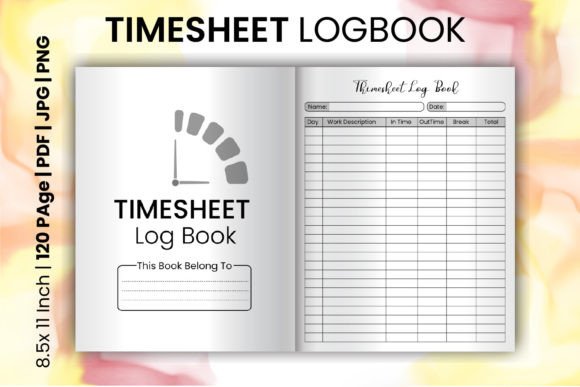
In today's fast-paced world, where freelancing, remote work, and entrepreneurial ventures are commonplace, tracking time effectively is no longer a luxury—it’s a necessity. For creators and business owners navigating the Amazon KDP (Kindle Direct Publishing) platform, managing projects, design time, and daily tasks can become overwhelming. Enter the Timesheet Logbook - Kdp Interiors, a specialized tool designed to bring order and clarity to your creative and business processes. This isn't just a notebook; it's a structured companion for anyone serious about optimizing their workflow and elevating their KDP business.
Understanding the Core Purpose
The primary purpose of the Timesheet Logbook - Kdp Interiors is to provide a dedicated space for meticulous time tracking and project management specifically tailored for KDP activities. Whether you're designing interiors for a new notebook series, plotting a publishing schedule, or managing the administrative side of your business, this logbook helps you quantify your efforts. By converting chaotic workflows into documented, measurable data, you gain insights into how time is spent, which projects are most demanding, and where efficiencies can be gained. This foundational data is crucial for pricing your work accurately, improving productivity, and ensuring your KDP venture remains profitable and sustainable.
Key Features and Practical Design
The design of this tool is rooted in practicality. Typically offered as a 120-page, letter-size (8.5 in x 11 in) volume, it provides ample space for detailed entries without being cumbersome. The "print-ready" and "no bleed" specifications are particularly important for KDP users, as they mean the provided files are formatted precisely for professional printing through the platform, eliminating technical hurdles. The inclusion of both PDF and PNG files offers flexibility; the PDF ensures consistency for printing, while PNGs might be useful for previews or digital customization. Key features often include:
- Dated timesheet sections for logging hours per project or task.
- Clear areas for client or project names, descriptions, and rate calculations.
- Integrated daily planning pages to align time tracking with overarching daily goals.
- A straightforward, clean layout that minimizes distraction and maximizes utility.
This combination transforms the book from a simple ledger into a comprehensive daily planner notebook for KDP business, merging the granular focus of time management with the broader perspective of day-to-day planning.
Who Benefits from Using This Logbook?
The application of the Timesheet Logbook - Kdp Interiors extends beyond a single user type. Its value is multifaceted, catering to a diverse audience within the creative and entrepreneurial space.
KDP Interior Designers and Creators
For designers crafting notebook interiors, journal layouts, or activity book pages, time is the direct input for their product. This logbook allows them to track the hours spent on each design, from initial concept to final print-ready file. This is vital for managing multiple projects, ensuring fair client billing if offering services, and understanding the true cost of their creations for their own KDP listings.
Self-Publishing Authors and Publishers
Authors using KDP for physical books often oversee formatting, cover design, and marketing. Using this tool to log time spent on these tasks helps demystify the publishing process, making it easier to plan future projects and decide if outsourcing certain tasks is cost-effective.
Small Business Owners and Freelancers
Any freelancer or solopreneur who juggles client work with their own KDP product line will find immense value. The logbook acts as a central hub to separate time invested in client projects from time invested in developing their own KDP catalog, providing a clear picture of business health and resource allocation.
Productivity-Conscious Individuals
Even those not deeply embedded in KDP but seeking a robust, paper-based system to tame their workday can adapt this logbook. Its structured approach to logging hours paired with daily planning encourages mindful work habits.
Real-World Applications and Scenarios
Consider a scenario where a creator is developing a series of daily planner notebooks for KDP. Using the Timesheet Logbook - Kdp Interiors, they can:
- Day 1: Log 3 hours researching market trends and sketching initial concepts for the planner layout.
- Day 2: Record 4.5 hours spent in graphic software creating the interior page designs, noting specific challenges encountered.
- Day 3: Track 2 hours for finalizing the PDF, uploading to KDP, and 1 hour for administrative tasks like keyword selection.
By the end of the project, they have a precise total of 10.5 hours invested. This data informs the pricing of the planner, helps estimate timelines for the next series, and identifies that the design phase is the most time-intensive part of their process. Another scenario might involve a freelancer who uses the daily planner sections to block out mornings for client work and afternoons for their own KDP product development, using the timesheet to ensure they stay within allocated hours, preventing burnout and overcommitment.
Evaluating Its Strengths and Practical Considerations
The strengths of this tool are evident in its specialization and format. It addresses a very specific need within the KDP ecosystem, which generic planners do not. The provision of editable, ready-to-upload files removes a significant technical barrier for users, allowing them to focus on content rather than formatting. The 120-page length offers a substantial period of use, suitable for quarterly or half-year tracking without requiring constant replacement.
However, its utility is inherently tied to a user's commitment to manual, paper-based tracking. For individuals who are deeply digital and automated in their workflows, the physical (or print-to-physical) nature might feel like a step back. It also requires discipline to maintain consistently; the value is cumulative and only realized through regular use. Furthermore, the "no bleed" design is perfect for the intended purpose but means the pages have standard margins, which is a practical consideration rather than a limitation.
Guidance for Choosing the Right Tool for Your Needs
When evaluating if the Timesheet Logbook - Kdp Interiors and its accompanying daily planner notebook are suitable for your KDP business, ask yourself these questions:
- Do I currently struggle to quantify how much time I spend on different aspects of my KDP work?
- Would having a clear, physical record help me make better business decisions regarding pricing, project selection, or time management?
- Am I looking for a structured system that combines detailed hour tracking with broader daily task planning?
- Do I value having professionally formatted, print-ready files that I can use immediately without additional design work?
If your answers lean toward "yes," then this specialized logbook could be a transformative addition to your toolkit. It serves as both a practical recorder and a strategic planner, aiming to convert chaotic effort into organized, actionable insight. For the KDP entrepreneur, time is a primary asset. Managing it with precision isn't just about organization; it's about building a more resilient, informed, and successful creative business.