The Practical Choice: Evaluating Daily to-Do List Notebook KDP Interiors for Self-Publishing
In the world of self-publishing on platforms like Amazon’s Kindle Direct Publishing (KDP), creating a physical notebook requires more than just an idea; it requires a ready-to-print interior file. For entrepreneurs and creators focusing on productivity tools, a Daily to-Do List Notebook KDP Interior represents a specific category of pre-designed, downloadable templates. These are essentially the complete inner pages of a notebook, formatted and structured for daily task management, packaged as a digital product for KDP publishers.
What Distinguishes This KDP Interior Option
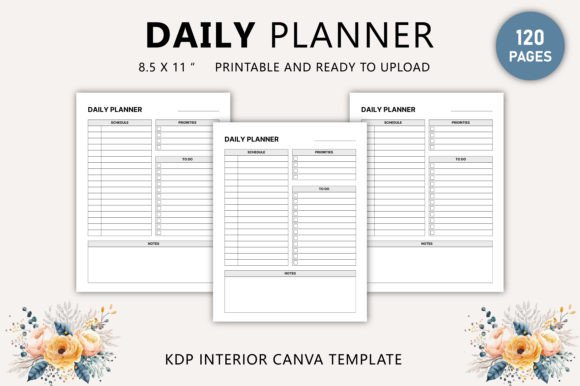
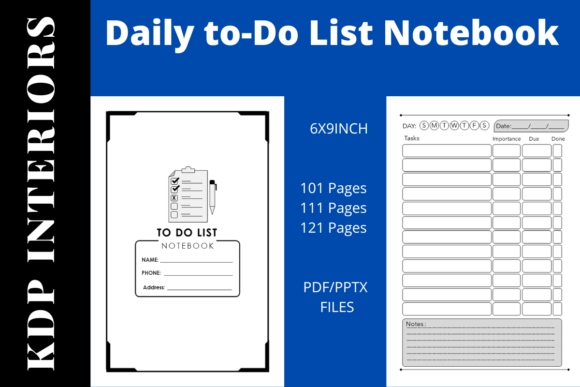
A typical Daily to-Do List Notebook KDP Interior is not merely a blank page file. Its defining characteristic is that it is a fully realized, purpose-specific layout. The design centers on daily task management, usually featuring dated pages, sections for prioritized lists, checkboxes, and often space for notes or time blocks. The provided specifications—such as 6x9 inches, 101-121 pages, no bleed, and ready PDF—mean it is engineered to meet Amazon KDP’s technical requirements for paperback interiors. This eliminates a significant technical hurdle for publishers.
Furthermore, the inclusion of a PPTX file alongside the PDF is a notable feature. While the PDF is the final, uneditable file for upload, the PowerPoint source file offers a degree of flexibility. It allows a publisher with basic design skills to potentially customize elements like header text or minor layout details, bridging the gap between a completely fixed template and a fully custom design.
Comparing This Approach to Alternative Notebook Creation Paths
When considering how to bring a daily planner notebook to market, creators have several pathways. Understanding where a Daily to-Do List Notebook KDP Interior fits within these alternatives is crucial for an informed decision.
Full Custom Design from Scratch
The most flexible alternative is hiring a graphic designer or learning advanced software like Adobe InDesign to create a unique interior from scratch. This approach allows for complete control over aesthetics, paper type simulations, unique section layouts, and branding. However, the tradeoffs are substantial: it requires significant time, expertise, or financial investment. For a creator whose primary value is in a unique artistic vision or a highly specialized planning system, this custom path may be necessary. The Daily to-Do List Notebook KDP Interior, by contrast, is a pragmatic solution for those whose priority is a functionally sound, quickly deployable product.
Using General-Purpose Blank Templates
Another common option is purchasing or using simple blank or lined KDP interior templates. These are versatile and can be marketed as generic journals. A publisher could then instruct users to employ them for to-do lists. The strength here is the product’s adaptability for the end-user. The limitation is that it does not provide the structured, guided experience of a dedicated daily task notebook. The Daily to-Do List Notebook KDP Interior explicitly caters to a customer seeking that predefined structure, which can be a stronger selling point in the crowded productivity niche.
Hybrid Solutions and Modular Design Tools
Some services offer modular KDP interior components—separate page designs for calendars, lists, or notes that can be combined. This offers a middle ground between pre-made and custom. Comparing this to a Daily to-Do List Notebook KDP Interior highlights a decision factor: integration versus cohesion. A modular set requires the publisher to assemble and paginate the interior, ensuring a logical flow. The pre-designed daily notebook interior is fully integrated and cohesive; the page sequence and daily structure are already decided and optimized, reducing the publisher’s editorial workload.
Strengths and Practical Considerations for Publishers
The primary strength of a Daily to-Do List Notebook KDP Interior is its turnkey nature. For a publisher with limited design time or skills, it represents a fast route to a market-ready product. The dimensions and no-bleed specifications mean it is pre-vetted for KDP’s paperback sizing, reducing formatting anxiety. The page count range (101, 111, 121) offers a choice for creating different product lengths, which can affect perceived value and pricing.
A practical strength is the focus on a proven, popular format. Daily to-do lists are a fundamental productivity method, ensuring the product has a clear and broad audience. By providing this specific layout, the interior helps the publisher tap into that demand without needing to research or validate the page design itself.
Recognizing the Tradeoffs and Limitations
While convenient, this approach comes with inherent tradeoffs. The most significant is limited differentiation. Since the interior is a pre-designed template, many publishers may use the same or similar files, leading to a marketplace with visually comparable notebooks. Your product’s uniqueness must then come from the cover design, title, marketing, and any minor customization you apply via the PPTX file.
Another consideration is the fixed functional scope. The interior is designed for daily to-do lists. If your target audience might prefer weekly overviews, project tracking pages, or habit trackers integrated within the same notebook, this specific interior may not suffice. It excels at a single, repeated function but does not easily accommodate hybrid planning systems.
When Is This KDP Interior the Right Fit?
A Daily to-Do List Notebook KDP Interior is an excellent choice under specific circumstances. It is well-suited for publishers who are testing the KDP market or expanding their catalog efficiently. If your goal is to launch a clear, functional productivity notebook without becoming a notebook design expert, this resource aligns perfectly with that objective.
It is also a strong fit for publishers whose competitive advantage lies elsewhere. Perhaps you excel at crafting compelling book covers, building author brands, or executing targeted marketing. In this case, leveraging a professionally formatted interior allows you to focus your energy on those strengths, while the product itself remains high-quality and user-ready.
When to Seek Another Option
You should consider alternative paths if your notebook concept is central to a unique planning methodology or brand identity. For example, if you are a productivity coach selling a notebook based on your specific “time-blocking” system, a generic daily list interior may not reflect your method’s nuances. Here, a custom design or a more adaptable modular template would be preferable.
Similarly, if you aim to compete in the high-end, artisanal notebook market where paper quality simulation, intricate layouts, and unique typography are key value propositions, a pre-designed interior will likely feel too generic. The investment in a custom design becomes necessary to meet customer expectations in that niche.
Making an Informed Decision for Your Project
Evaluating a Daily to-Do List Notebook KDP Interior ultimately comes down to assessing your resources, goals, and market positioning. Consider your own skills and time. Do you have the capacity and desire to learn interior design software? Is your budget better spent on marketing rather than custom graphic work? Assess your target audience. Are they looking for a simple, effective, and affordable daily task tool, or are they seeking a highly specialized planner that justifies a higher price point?
By comparing this ready-made solution against the spectrum of alternatives—from full custom design to blank templates—you can determine where efficiency and functionality outweigh the need for total uniqueness. For many pragmatic publishers, a Daily to-Do List Notebook KDP Interior provides a solid foundation, allowing them to enter the productivity journal market with a professionally structured product, ready to upload and sell.